On July 29 a number of updates to the draft UDO were released. Signs, landscaping, stormwater, open space, parking, infrastructure – all really important and we need to be talking about those.
Two significant updates have overshadowed everything else – the updated Draft 2 zoning map, and changes to the Rural Residential (RR) zone.
Zoning Map Changes
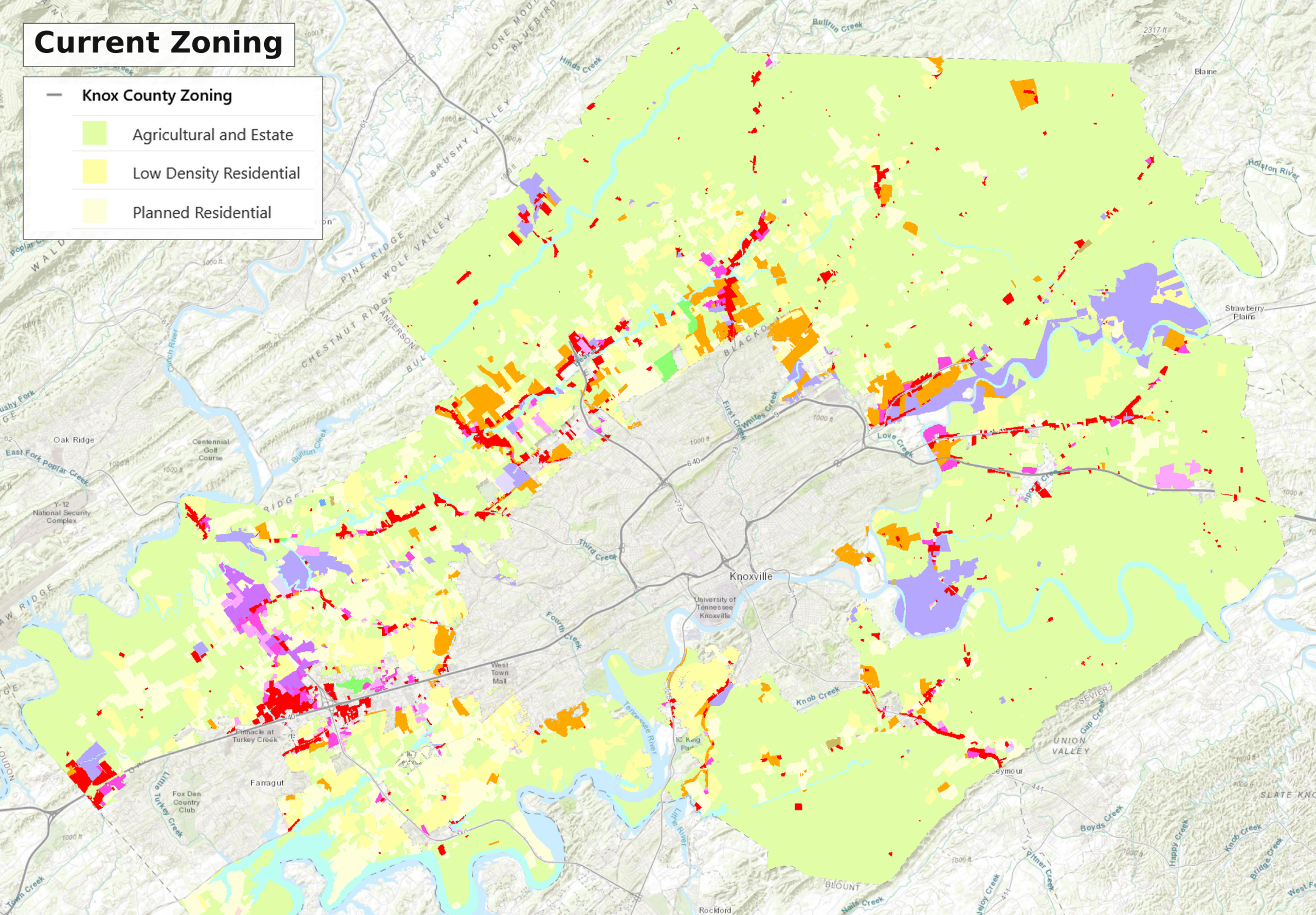
![]() Current Zoning
Current Zoning
About 174,000 acres of unincorporated Knox County are zoned Agricultural (A). Some of these are 1-acre lots with single family homes; not actively agriculture. But much of this is pasture, hay, forest, hillside and ridgetop.
UDO Draft Map 1
Draft 1 of the zoning map showed 10s of thousands of acres zoned Agricultural Rural (AR) or Rural Preservation (RP). Our KCPA Advocates attended the community meetings and we were impressed with the Draft 1 map. The large Agricultural Rural (AR) areas represent input those communities and farmers had provided 3 years ago in the initial Advance Knox phases.
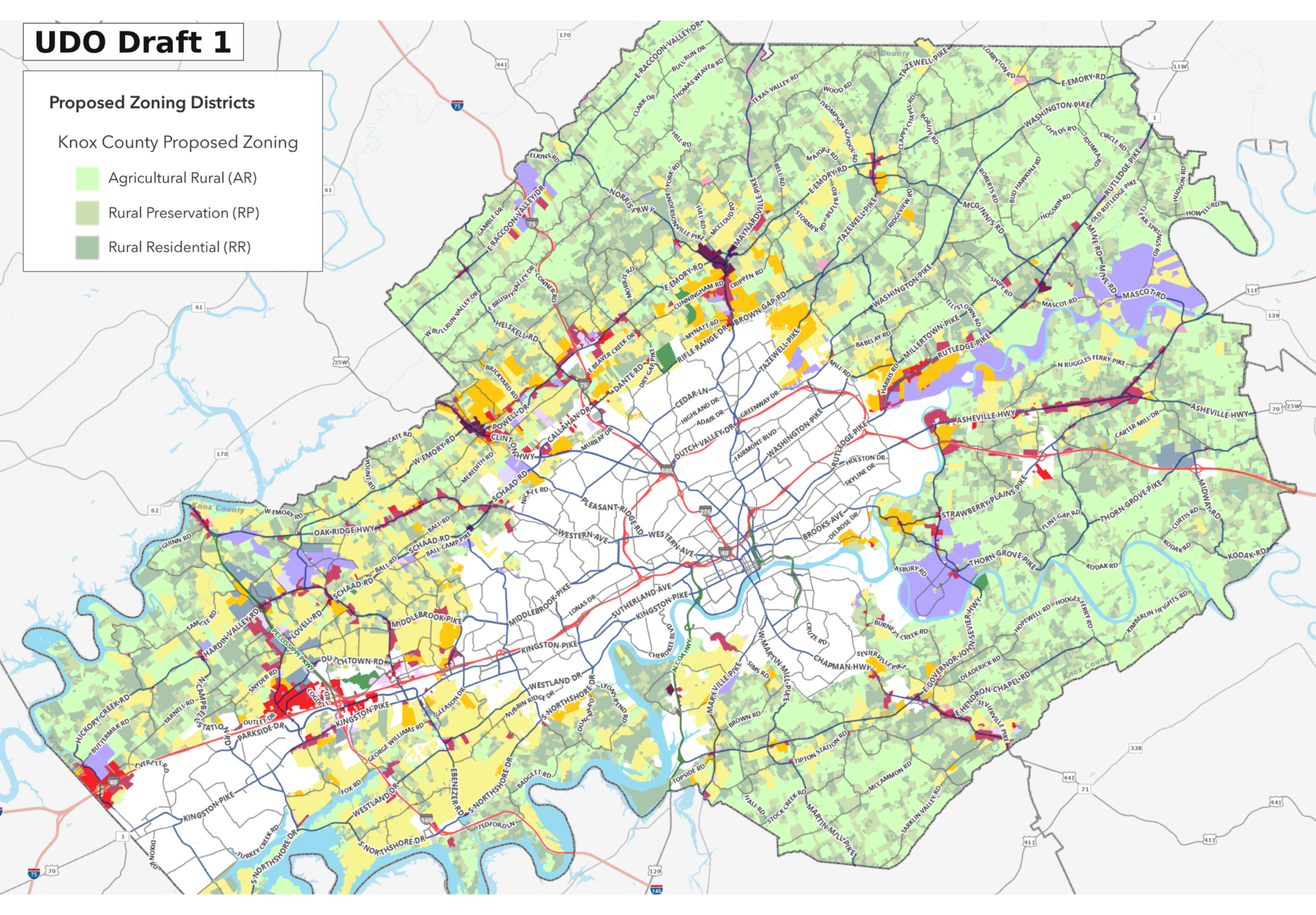
Placing all of those properties together puts property owners in the same boat. If you are zoned AR, and your neighbors are zoned AR, you feel like the area will stay large-lot agricultural. You invest in your farm and help your adjacent neighbors with their farm. It creates stability, preserves farmland, and keeps the rural character of the county. The RP zone was applied in areas of hillsides and sensitive areas to allow some development where infrastructure already exists while also requiring conservation areas and styles that preserve sensitive hillsides, ridgetops, and environmentally sensitive spaces. To KCPA, Draft 1 map represented the direction we hope Knox County will take.
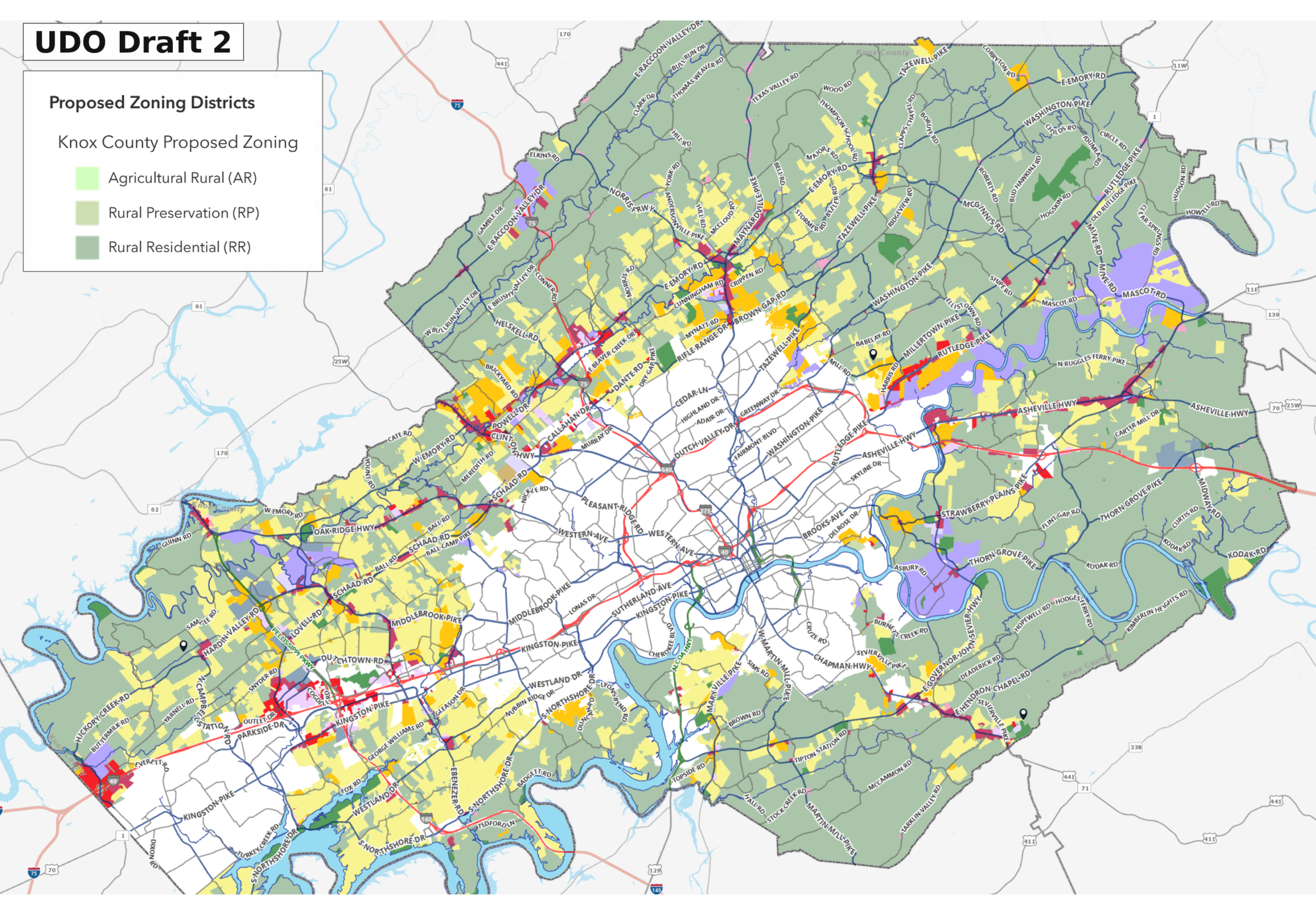
Draft 2 Map
Draft 2 of the zoning map shows zero (0) acres zoned AR. Anything that was previously Agricultural (A) is now proposed to be the new Rural Residential (RR) zone (except 112 acres of currently zoned Rural Preservation that remains Rural Preservation). This is a very big change. KCPA frames this as a radical U-turn from the direction that the UDO was taking for our farmland and rural areas.
The Advance Knox website has a page with additional information on the Agricultural zoning change. The county has proposed a process where property owner whose property is proposed to be zoned Rural Residential (RR) may request either Rural Preservation (RP) or Agricultural Rural (AR). Initially there was a deadline to send that form in by August 31, 2026, but that has been removed and will be allowed up until the UDO is adopted.
Rural Residential (RR) Zone Changes
The Rural Residential (RR) zone was supposed to be the rural zone that allowed lots of half acre or 1 acre lot sizes. But a change inserted in the July 29 update will allow subdivision-type development at 2 units per acre if you meet a couple of conditions.
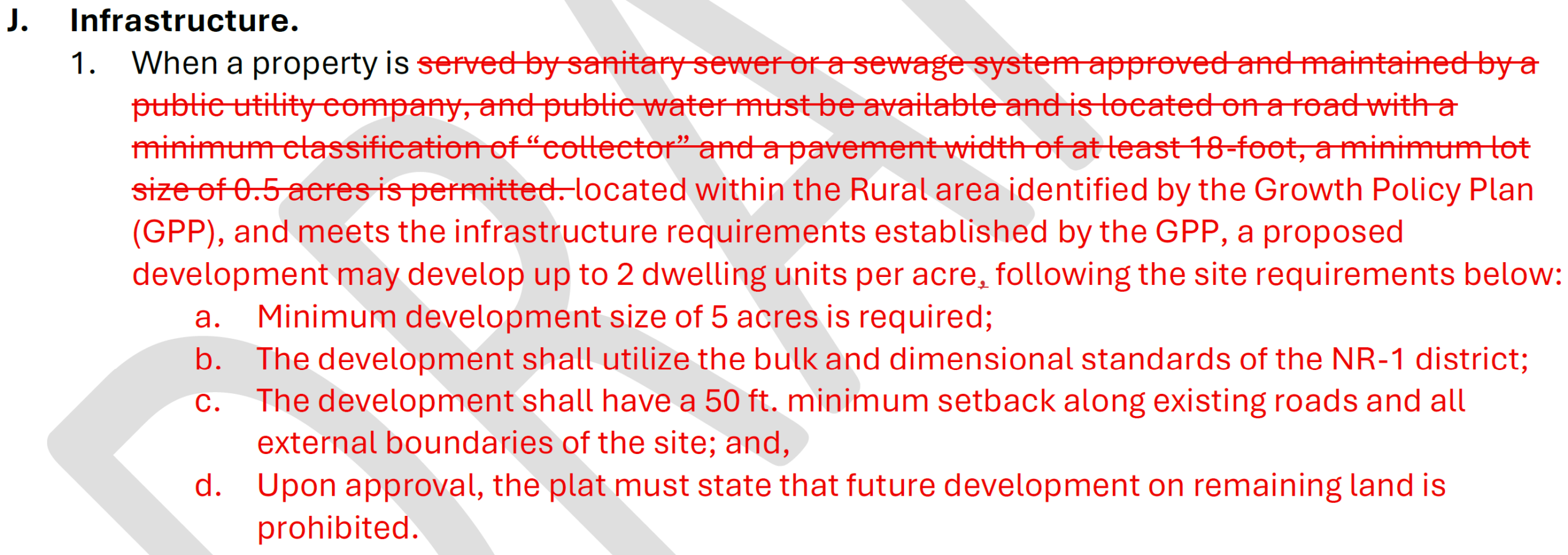
- Growth Plan infrastructure requirements are:
- Sanitary sewer, or a sewage system approved and maintained by a public utility company and public water must be available (that means the utility gives you a letter saying that it’s available and what it’ll cost to build it, not that the line is actually there in on the property)
- Be on a classified (collector or arterial road) that has an 18′ wide road or will be widen it to 18′
- Minimum development size of 5 acres (could be a couple of smaller parcels next to each other, or a larger parcel like 40 acres)
Then you can build at 2 units per acre by right, as long as you keep 50 foot setbacks along the perimeter.
It allows single family residential lots to be built to the same bulk and dimensional standards as the new NR-1 zone. That means a minimum lot size of 5,000 sq ft, not half an acre. This is what we’re used to with Planned Residential today – number of dwelling units = development size (acres) * units per acre. See below – if you have a 40 acre parcel meeting the requirements, you can build 80 single family dwelling units. This shows 78 of those built on 5,000 sq ft lots and the other 2 as remaining large lots.
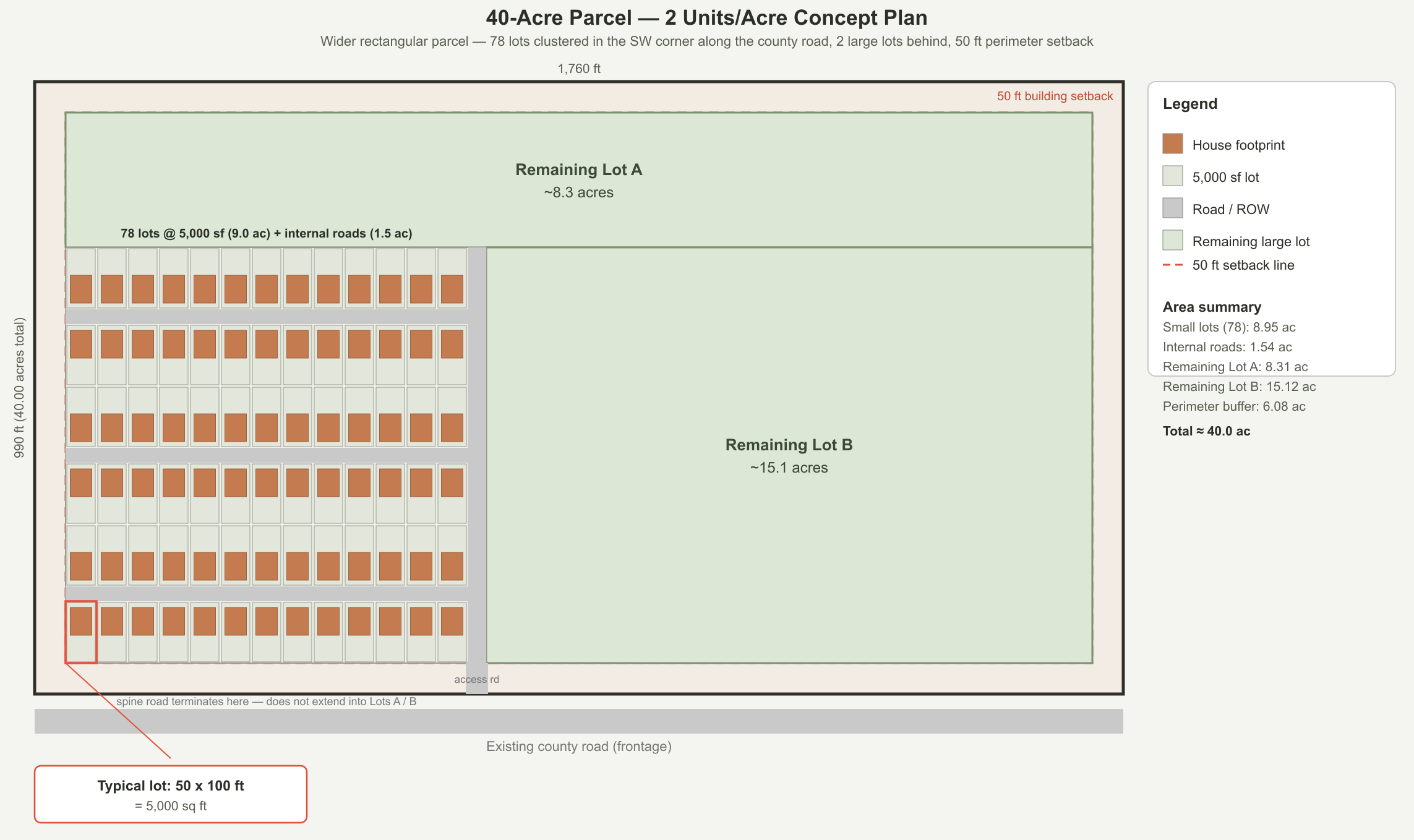
It requires a Concept Plan, which does go before Planning Commission and may trigger a traffic study. The details of all this are still being written and TBD. But Concept Plans are an administrative function, and if an application checks all the boxes, a Concept Plan is approved. Then just file a final plat, pull grading and building permits, and go. Our experience with Concept Plans is that they are engineering processes. To go to Planning Commission and contest these requires hiring a licensed engineer who comes to a different conclusion and will testify as such. This is time consuming, expensive, and honestly there aren’t a lot of licensed engineers that want to testify against developers who write most of the checks to them.
No County Commission approval required.
THE RESULT
KCPA sees that the proposed map is a “One and Done” rezoning of the entire rural county that makes it attractive for development. It vests development rights of 2 units per acre as long as you have 5 acres, can get sewer and are on a classified road (collector or arterial). What we’re seeing on Roberts Rd in rural Corryton, we will see in other places. Rural Residential (RR) zoned property can and will be developed.
The likely result is:
- Sprawl and increased development. Since no rezoning is required, a developer just has to find an owner willing to sell 5 acres or more, file a subdivision plat, and then pull grading and building permits. This map and zone is a Golden Ticket to developers who go in and build a bunch of houses without further public process. The new zoning map is the final step for zoning in Knox County.
- Congested Roads. The county spent a lot of money developing traffic plans for Hardin Valley, Northeast / East Knox County, and Choto. The proposed map opens up development in those areas and many others. Roads which weren’t planned to be more congested will be. And due to recent state law changes (probably pushed by homebuilders and realtors), Knox County can only require developers to pay just a portion of the road cost.
- Expensive Housing. Single family detached housing permitted by this zone is simply expensive to build today. This development doesn’t create new housing at affordable price points for Knox County residents. And it allows development in rural areas where residents have to drive a long way to get to grocery, restaurants, schools, and parks. More gas $$$, no public transportation, more school buses on longer routes, more sheriff and ambulance protection needed in rural areas. It costs more.
- Loss of Knox County Identity. This is the opposite of conserving farmland and helping families stay in agriculture. They will get more phone calls, more letters offering to buy land. The county is doing nothing to help them.
WHAT SHOULD WE DO?
KCPA believes the Draft 1 map was really good. This will be taken up by incoming Knox County Mayor Betsy Henderson who takes office Sept 1st. We urge the new mayor to go back to that map, and to revert these changes to the Rural Residential zone. The Opt-In deadline has been removed (you now have until the map is implemented).
The map and proposal are a draft. You can stop this. We suggest:
- Email the current and incoming county mayor and county commissioners. Give them your address so they can map your comment. Ask to revert to the Draft 1 map and reverse the change to the Rural Residential zone. Tell them why rural areas, farms, open space, etc. are important to you. Tell them what is on your mind.
- Don’t forget the other material introduced. Take the surveys on the Module D articles. The most common complaints are about roads and stormwater. Guess what – that’s Article 18 and Article 19 this month and there are surveys for those modules.
- Be prepared to engage and advocate with the new County Mayor and to County Commissioners in September.
- Share this page with your friends.
If you have questions, email the UDO team: contact@advanceknox.org. KCPA is not the project team; we are an advocacy organization and have posted our interpretation of this proposal.
Terms end August 31st, and on September 1st there will be a new mayor and 4 out of the 11 county commissioners will be new. The new mayor will make decisions on what is sent to county commission for a vote. Our experience is that we want the mayor to send the best proposal possible. When the mayor sends a bad proposal forward, we’ve found it’s difficult to change or defeat.
The changes presented are still just proposed, and the zoning map is still in draft form. This will not be introduced to be voted on by current Mayor Glenn Jacobs or the current county commission. Getting active and showing up to public commission meetings in August is talking to a lot of folks who won’t be involved.
If I have land zoned Agriculture that is proposed to be rezoned to Rural Residential, do I need to get an Opt-In Form submitted by August 31st?
First – the August 31st deadline has been removed. We have been in touch with the team, and they are accepting forms on a rolling basis up until the plan is adopted. More communication will come out, but that deadline is no longer on the form or website.
The county has a website on the Agriculture zoning and is adding material to it – please go here for the latest info: https://advanceknox.org/udo/zoning/agriculture
As for “should I submit it?” Something influenced this process and changed the rules of the game with this new map and zoning. It created new rules, including this Opt-In process, because it benefits that influence. But they didn’t provide any incentives for you to request being zoned either the RP or AR zone. If you have a commercial farm (sell stuff), you’re going to be able to keep farming thanks to the Tennessee Right to Farm laws.
If you don’t like how this has gone, the most effective way to voice that is to take action and send an email to the current and incoming mayor and county commissioners. Don’t just meekly submit a form and play by these rules and give up something in return for nothing.
You can always send in an Opt-In form to show your support of these new zones, but make sure you take the time to understand the different zones and implications before you do. If you have questions about that, email contact@advanceknox.org.
Why was this change made?
The release stated that it “honors the rights property owners have today while giving them the choice to apply a new, more restrictive district to reflect the rural character or agricultural uses on the property.” But note – there are no incentives though for adopting a new, more restrictive district. Zero.
KCPA’s Council of Advocates has a number of former folks who have been on the Planning Commission – neighbors who volunteered time to serve. A couple of have degrees in public planning. They’ve learned about planning, best practices, and asked how to prevent sprawl and help change land. None of them think that this proposed map and zoning change is fiscally responsible or represents a best-practice of planning.
It appears to us to be a the “property rights” view winning out over fiscally responsible planning. And while the change is a “property rights” move, the term “property rights” does not appear in the adopted Comprehensive Land Use Plan anywhere – as a priority, goal, objective. Nowhere.
Who made this change?
Not publicly stated.
KCPA advocates were impressed with the Draft 1 map; we though it reflected the community input, directed growth along corridors and areas where there is significant infrastructure, and protected farmland and rural areas.
The Big U-Turn of Draft 2 doesn’t make sense. In our experience, this means “Politics and Backroom Influencers Have Entered the Chat”. We suggest “Follow the Money”. Look to businesses and industries that make money off of developing land and how they influence elected officials. Besides local firms, there’s an awful lot of out-of-state money looking for investment opportunities. Campaign finance disclosures are available at the Knox County Election website.
Does this change reflect the priorities of Advance Knox?
In our opinion – No. Before the map was released, County Mayor Glenn Jacobs stated the priorities in this video: “Our residents want infrastructure investments, housing options where infrastructure is present, and to conserve our farmland and natural spaces.” He also stated that updating our regulations would prevent sprawl. We agree that is what community input requested and reflects priorities of the adopted plan.
We cannot connect that statement with the Draft 2 changes. We think the outcomes will be the opposite – increased development of farmland and natural spaces, and additional housing farther away from infrastructure and services. The Rural Residential zone is applied to 10s of thousands of acres of farms and forestland in Knox County. The zone imposes no design guidelines on what this should look like and no requirements to comply with the rural area character. There are no incentives to zone property Agricultural Rural or Rural Preservation. There are no standards for transition zones between AR and adjacent RR or RP housing developments. It vests higher density on many of those parcels with sewer and roads than they have today. This opens up land for low density development (sprawl). Period. Full stop.
As a refresher, the top 4 community priorities surfaced in phase 2 of Advance Knox, in ranked order, were:
- Infrastructure investment – efficient infrastructure investments that support and anticipate planned growth and are maintained through strategic, fiscally responsible decisions
- Conservation – conservation of natural areas and resources that include ridges and valleys, rivers and streams, wetlands, historic and agricultural assets and scenic views
- Housing Options – housing and neighborhood options that meet a wide range of types, locations, affordability to meet the need of a growing and changing population
- Community Character – strong places with distinct identities, including natural areas and development models that range from employment centers to rural communities and include walkable neighborhoods and mixed-use centers.
While the change is a “property rights” move, the term “property rights” does not appear in the adopted Comprehensive Land Use Plan anywhere – as a priority, goal, objective. Nowhere.
This change also doesn’t reflect the priorities of the East Knox Community Plan, which is a part of the Comprehensive Land Use Plan. Take a look at that document to see a path for what we want to see in rural areas.
Should We Get Rid of Advance Knox / Scrap the UDO?
No, absolutely not. We cannot keep developing the way we have been – sprawl, a process that favors developers who have influence, sucks up time from the public and residents. Cancelling the UDO means the current rules stay on the books.
Advance Knox hasn’t been perfect. But, it has collected input from thousands of residents. Community members and staff and consultants have put in thousands of hours and put forth some good ideas.
The Growth Plan map and future land use map aren’t perfect, but County Commission could, and should, propose changes to tighten those up.
The UDO is making progress in the right direction. Last year KCPA published a Policy Statement of what we hope to see in the UDO. We can still get there. We were almost there with the Draft 1 map and zoning regulations.
Scrapping the input of thousands of residents and the quality work that has been done already would be not only an injustice, but would keep us using the same system that hasn’t worked for our county for 20+ years.
Does this change reflect Tennessee priorities?
We can’t speak to every priority of the State, but this change surely doesn’t support the statewide priority of addressing accelerating rates of farm land loss. In his 2024 State of the State address, Governor Bill Lee said “Off the major highways are the drivers of Tennessee’s economy – Tennessee farmers. Our agriculture industry employs more than 360,000 Tennesseans and generates $89 billion annually, making agriculture the number one contributor to our state’s economy. Yet, today, we are ranked the third-most threatened state for farmland loss in the country.”
Read this recent article from UT Extension: https://landlifeandscience.tennessee.edu/periodical/spring-2026/stemming-farmland-loss/. Our rate of farmland loss is INCREASING, not decreasing.
What about an “Opt-In” approach?
We urge NOT having an “opt-in” process where somebody proposed for Agricultural Rural (AR) could request and be automatically granted Rural Residential (RR). You’ll find developers have land banked all over the county.
When the City of Knoxville did Recode and adopted a new zoning code and map, it allowed land owners some time (1-2 years) after the county rezoning to submit an application to rezone if they believed their property had been misclassified, and they didn’t have to pay a rezoning fee. That was a good process and we urge the County to follow the same.
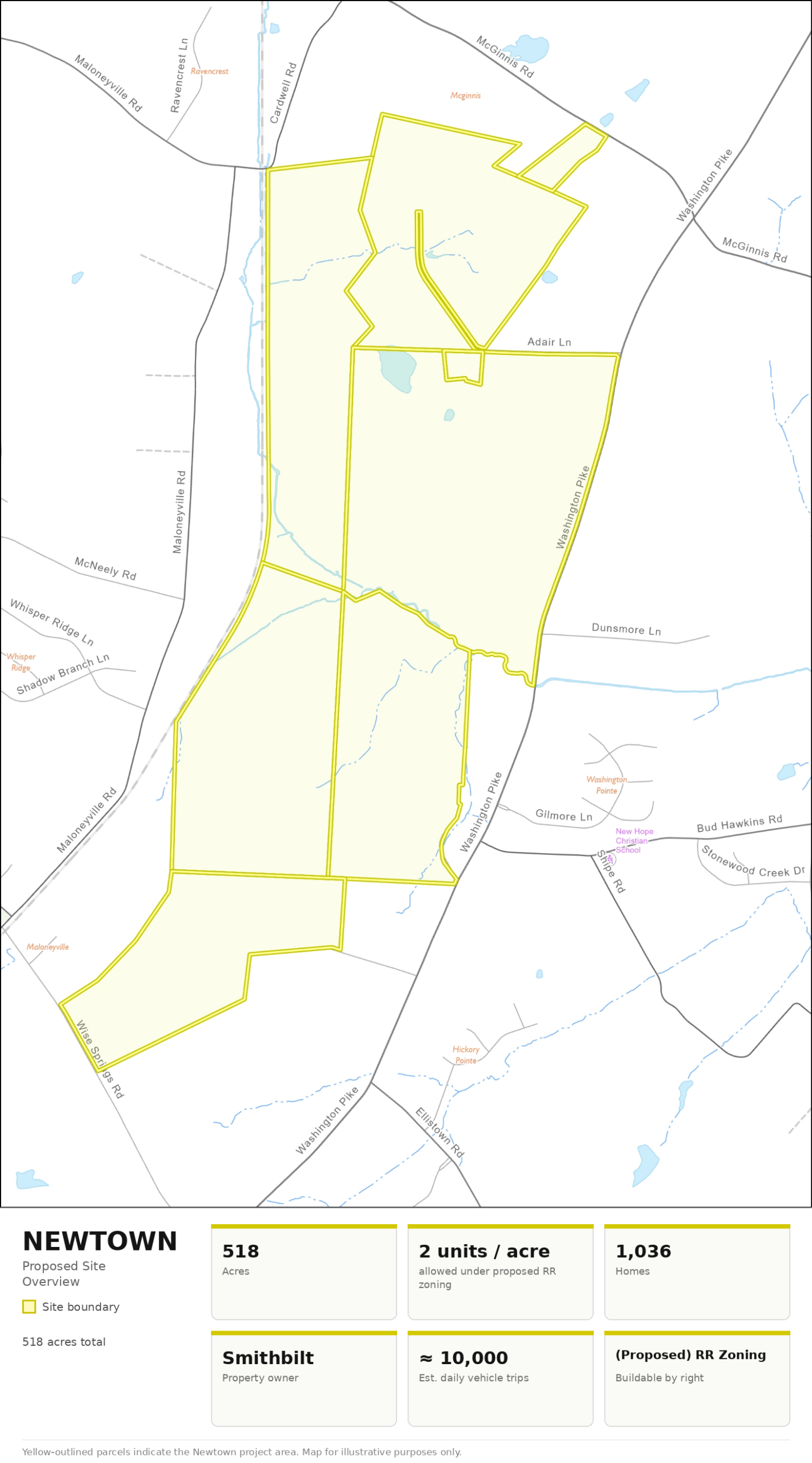
For a concrete example of what would happen if an Opt-In approach allowed a landowner to receive the RR zoning just by submitting a form: Smithbilt owns 518 acres in Corryton, along Washington Pike just past Wise Springs Rd. They could submit a form to have all of that as Rural Residential. The zone would be applied with the zoning map, and they would be vested with the right to develop at 2 units per acre if they can get sewer, road width, and meet the conditions of a traffic study. We think sewer is already there, road width is there, so all they need is to get approval for the traffic study.
What did the county’s Fiscal Impact Analysis tell us about low density residential development?
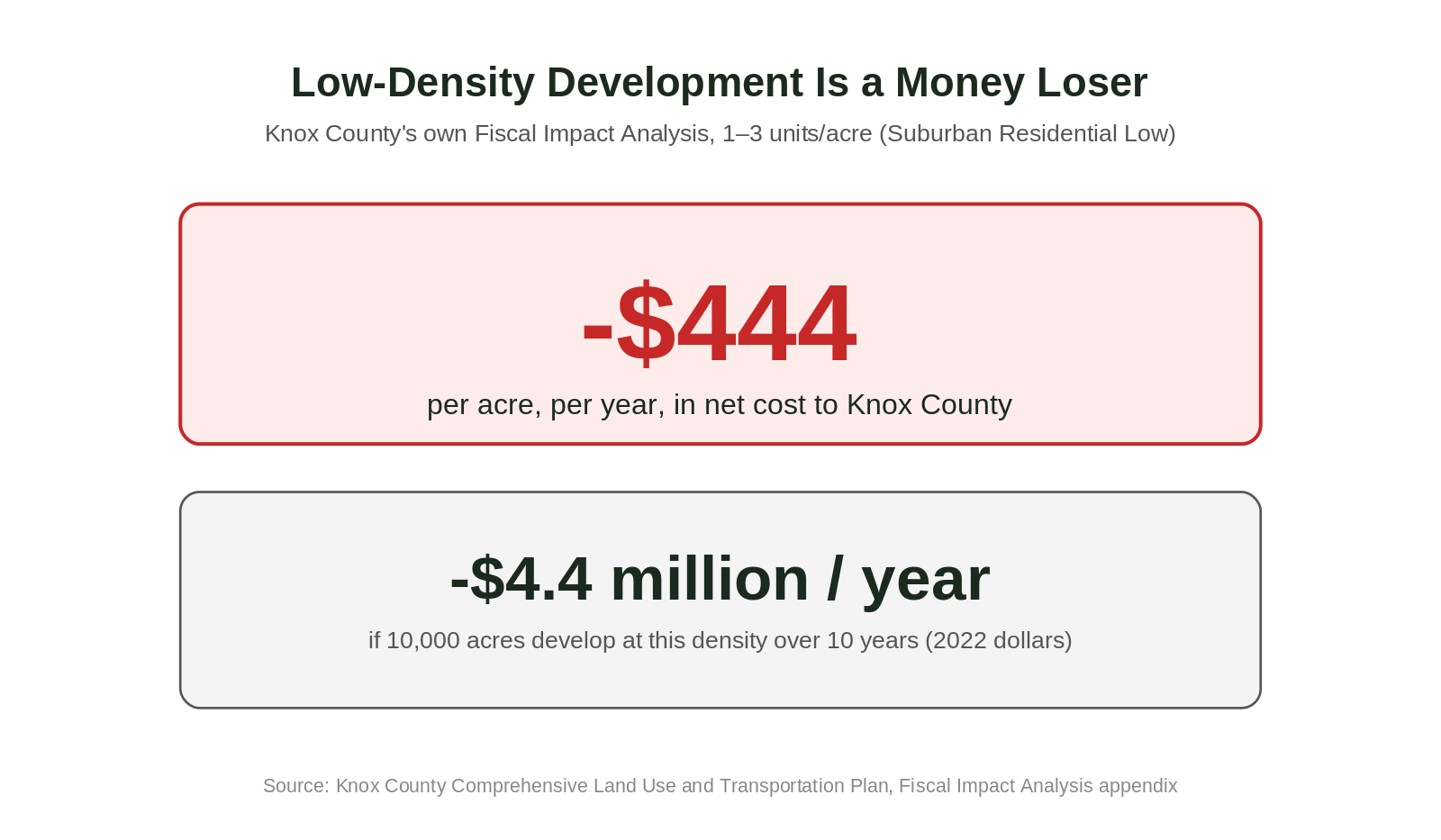
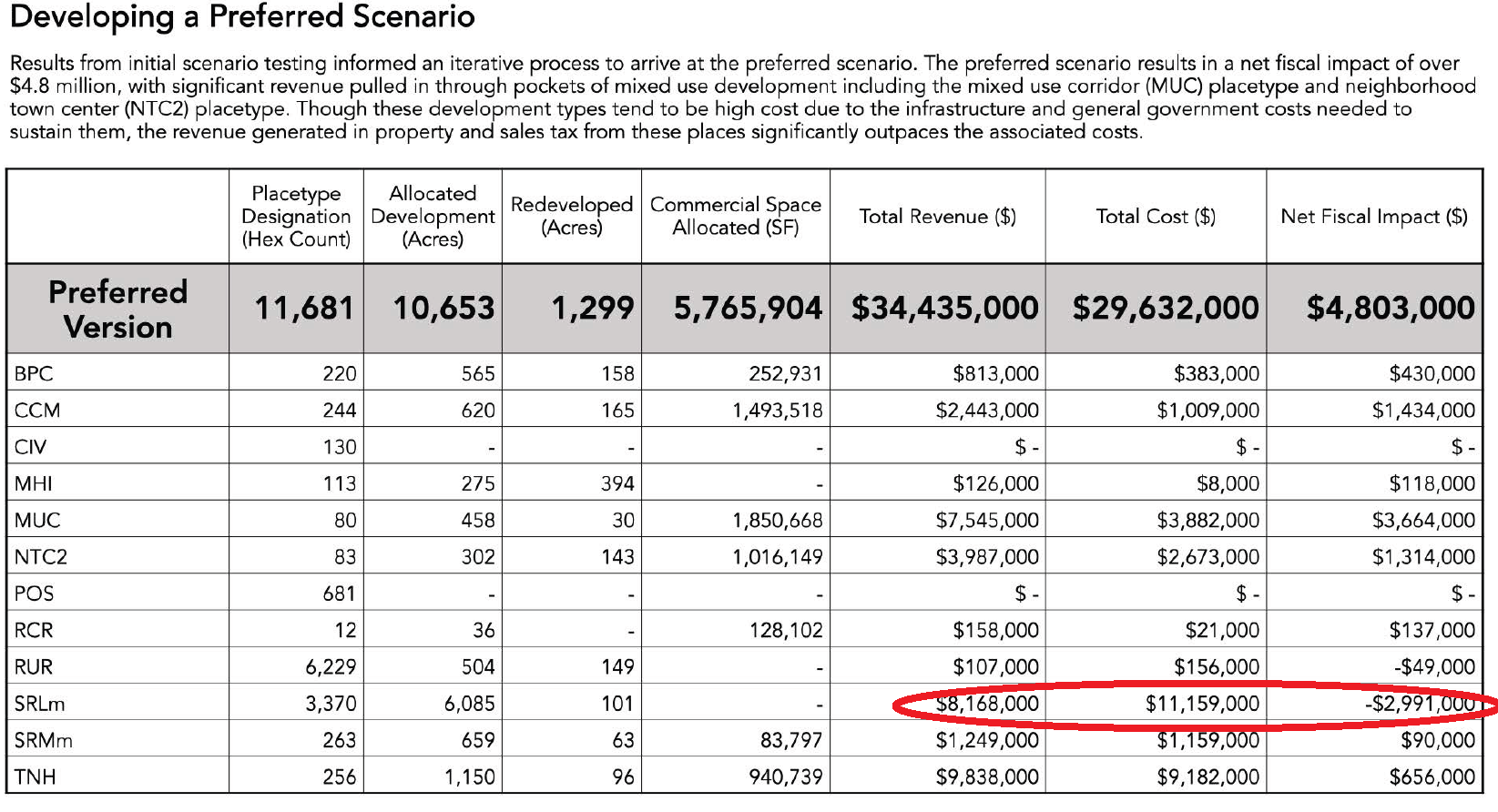
Low density residential development (1-3 units per acre) in Knox County is a money loser. The County had a third-party prepare a Fiscal Impact Analysis that showed that It costs more to provide services and the development brings in. In other words, this 2 unit per acre development keeps digging Knox County into an even deeper fiscal hole, and is not a fiscally responsible or conservative way to develop.
The Fiscal Analysis used a Suburban Residential Low (SRL) placetype with Single Family Detached housing at 1 to 3 units per acre. The Fiscal Impact Analysis concluded that development at 1-3 units per acre would cost Knox County $444 per acre each year. If we developed 10,000 acres over the next 10 years at this density, we’d burden the county with an additional negative revenue of $4.7 million annually (in 2022 dollars).
What are the likely results of this Rural Residential zone applied to the Rural Area?
- Sprawl and increased development. Since no rezoning is required, a developer just has to find an owner willing to sell 5 acres or more, file a subdivision plat, and then pull grading and building permits. This map and zone is a Golden Ticket to developers who go in and build a bunch of houses without further public process. The new zoning map is the final step for zoning in Knox County.
- Congested Roads. The county spent a lot of money developing traffic plans for Hardin Valley, Northeast / East Knox County, and Choto. The proposed map opens up development in those areas and many others. Roads which weren’t planned to be more congested will be. And due to recent state law changes (probably pushed by homebuilders and realtors), Knox County can only require developers to pay just a portion of the road cost.
- Expensive Housing. Single family detached housing permitted by this zone is simply expensive to build today. This development doesn’t create new housing at affordable price points for Knox County residents. And it allows development in rural areas where residents have to drive a long way to get to grocery, restaurants, schools, and parks. More gas $$$, no public transportation, more school buses on longer routes, more sheriff and ambulance protection needed in rural areas. It costs more.
- Loss of Knox County Identity. This is the opposite of conserving farmland and helping families stay in agriculture. They will get more phone calls, more letters offering to buy land. The county is doing nothing to help them.
What are the exact conditions required to build at 2 units per acre?
Rural Residential (RR) zone allows minimum lot sizes of 1 acre in the Rural Area and 0.5 (half) acres minimum lot size in the in Planned Growth Area. Similar to today’s Ag zone (which is a minimum of 1 acre to have a dwelling unit). But in the Rural Area, if you meet 3 conditions, you can build at 2 units per acre:
- Minimum of 5 acres (can be multiple adjacent parcels put together),
- sanitary sewer, or a sewage system approved and maintained by a public utility company and public water must be available, and
- must be on a collector road with a minimum width of 18ft pavement, or with an approved memorandum of understanding in place to improve the road to 18ft or greater through the rural area to the adjacent Planned Growth or Urban Area.
The development would require 50 foot building setbacks along the perimeter. That’s building setbacks, not a “no disturbance” zone. Developers can still grade right up to your property line.
Any land not allocated a dwelling unit would have to be stamped “No further development”. If you had 100 acres, built 200 homes on 30 acres and left 70 acres without any dwelling unit allocated, then the 70 acres would be stamped “No further development allowed”.
KCPA notes that this has not yet been tested. The Growth Plan section 4.3 is ambiguous – if you are not on a collector road but an arterial road, do you meet the condition? What if you are on a local road and will improve it to 18 feet width to the Planned Growth or Urban Area – can you develop then? Might only mean you need to widen 1,000 feet of road till you get to a collector road. And also, the proposed RR zoning text appears to apply to just the Rural Area. What about the Planned Growth area – would 5+ acre lots be eligible to use the smaller bulk and dimensional standards of the NR-1 zone?
How is sewer infrastructure planned?
Sanitary sewer is planned by the public utilities – KUB, Hallsdale Powell, Knox-Chapman, West Knox, First Utility District. Knox County isn’t in control of the process, except that the county mayor may nominate some of those board members. Their mission is to provide service to their customer area. If a property doesn’t have sewer service but wants it, the utility will work to see if it can be provided and at what price. Our conversations with their boards indicate that in almost all cases they are looking for that applicant to pay for the extension of sewer lines if they are needed. We’re unsure about what happens if new development requires capacity increases – who pays for that?
Regardless, sewer availability is not managed by Knox County and it doesn’t come up for a vote at County Commission. It’s up to the individual utilities to manage.
Under the rules in the Growth Policy Plan 2024 amendment and these proposed changes, sewer availability drives development. Just as it has for 50+ years in the county.
What incentives are there for a property owner to request a more restrictive AR or RP zoning?
There are no incentives. AR and RP zoning offers no benefits for property owners. The Draft 1 map at least zoned many property owners into AR and RP. If you are zoned AR and your neighbors are AR, you may feel like “we are all in the same boat, my neighbors are going to be a farm, and if there’s a change, there will have to be a rezoning discussion.” Now the default is “My neighbor is RR, and if a developer can convince them to sell, that property is going to get developed. Why would I want to invest in my farming operation when I could easily have a subdivision next to my cattle fence in a few years?”
Does this zone impact my eligibility for the Greenbelt program for property taxes?
It shouldn’t. Eligibility for the greenbelt program is determined by use and acreage. If you’re growing trees or agricultural products and have 15 acres, you should qualify for the greenbelt program; eligibility is not tied to zoning.
However, if your land is not in the Greenbelt program, it is assessed and taxed at market value. A Rural Residential zoned property with higher development potential may become more valuable, resulting in higher appraisals. Also, as property around you develops, your property may become more attractive and be assessed at a higher value than if your property and property in the area remained zoned Agricultural. Questions should be directed to the county Property Assessor.
Can I still farm if my property is zoned Rural Residential?
Mostly. Various “uses” are permitted in each zone. The Advance Knox team has a page on this topic which is being updated and will have the most more recent info: https://advanceknox.org/udo/zoning/agriculture
Tennessee has a Right to Farm law for commercial farm production. There’s a lot to it; perhaps this TN Farm Bureau document will help.